The Nose of the Boar

My wife and I just returned from a week in Italy, Florence to be exact.

This whole thing started by planning a run-of-the-mill trip to San Francisco. It was last September. I was on the Web, checking out fares and accommodations, getting a line on some pretty good deals. Then I started thinking about it. What, exactly, were we going to do in San Francisco? We could visit some friends and relatives, maybe see an art opening, but in fact we had already seen all of the “sights” on our last trip there. And in truth I had no great desire to go back.

Then I started thinking, “Well, then, where do you really want to go?” And I knew right away it must be Florence.

I had visited Florence once before, when I was a lad of twelve. My family was living in Naples at the time (a great place to live, but you wouldn’t want to visit there). We drove up to Florence for a two or three day visit.

When we got there I was immediately blown away. The city itself is a work of art. The narrow cobbled streets, the ancient buildings, the winding Arno and its beautiful bridges, all surrounded by the rolling Tuscan hills. This is the city of the great Medici, the city of the Renaissance. Here is Brunelleschi’s famous dome for the cathedral of Santa Maria del Fiore (AKA the Duomo). Here is the Uffizi, the greatest museum of the world (with the added feature that it is not in France). Here are dozens of important basilica, cloisters and cappella. Here is the home of Dante, of Galileo, of Michelangelo. Here is the birthplace of modern art and science.

Of course, I didn’t quite see it that way at age twelve. But I knew I was in a magic place, a place that exists outside the mundane world of office towers, malls and suburbs. I knew the streets were for walking, and that the cafes were for idling, and that the people were alive to it all. I saw Botticeli’s Birth of Venus and knew I was in the presence of a masterpiece. I drank wine in a family-owned Trattoria and strolled to the Mercato Nuovo, an open-air market famous for leather and stationery, where I rubbed the nose of the boar.

And in truth, that was it. I had forgotten, until some days after I had convinced my wife that Florence was our destiny, after I had booked the flight and the townhouse, after I had checked out my Italian language CD from the library–I’d forgotten that on that chilly night in 1974 I had in fact rubbed the nose of the boar at the Mercato Nuovo. The boar in question is a large bronze statue of same, one of the several symbols of Florence. Its nose is kept perpetually shiny by the hands of a thousand tourists a day, all of whom know that a visitor who touches the nose of the boar is guaranteed to return to Florence one day.

As I did. And I am forever thankful to that boar.
Merry Christmas – Happy New Fear

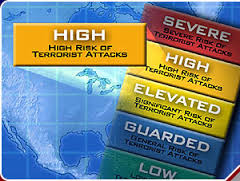
I very much would like to tell Tom Ridge what he can do with his orange alert.

I guess it’s just not the Holidays here in the good ol’ US of A anymore without a healthy dose of fear courtesy of Uncle Sam. Just when you thought you could perhaps relax a little, shift the weight of the world from your shoulders a little and take a small amount of comfort in what remains to you in this fractured, soulless society – namely, family – along comes our beloved, rumor-mongering officials with yet another cry of wolf, another announcement that the sky is falling, another whimper into the pillow.

orange

Eventually they will be right, just as I would be if f I step outside every day and say, “Today it will rain.” But that doesn’t make what they are doing right. On the contrary, they have already squandered their stock of credibility on the parade of orange alerts that have come and gone with no disaster. Their message may be an authoritative warning in their eyes, but to me and everyone I know it is heard as a pathetic excuse for a spectacular failure to fulfill their mission to protect this nation.

When Tom Ridge speaks, this is what we hear: “We are incompetent and impotent in the face of this small band of loosely organized thugs. After all, we’re just the United States of America, but these guys are fanatics with e-mail. They frighten us. Aside from announcing the coming strike, there’s really nothing we can do except await the next blow from these half-mad, unarmed, rag-tag outcasts of society. Because despite a $400 billion defense budget and the combined resources of the wealthiest nation on earth arrayed against them, they remain one step ahead of us at all times. After two years on notice that they are out to destroy us, we continue to scratch our heads and wonder what to do.”

Here’s the tally on the U.S. versus al Qaeda:

  • They attacked New York and Washington, so we attacked the Taliban
  • They remained a threat after the Afghan war (because we let them run away), and Osama remained alive, so we attacked Iraq

We know where the leaders are – always have known – but even though they have no arms to speak of, no tanks or missiles or even significant numbers of men, we can’t go get them. The reason? Simple – they are in a “lawless mountain” region. Again – $400 billion a year, the most sophisticated equipment in the world, half a million soldiers – but we just can’t hack it in those mountainous, lawless regions. So we wait for them to strike us again.

But in contrast to the fatalistic hand-wringing of Tom Ridge, at least we have General Myers, chairman of the joint chiefs of staff, who the other day provided us with this confidence-inspiring analysis in the press:

“There is no doubt, from all the intelligence we pick up from al-Qaida, that they want to do away with our way of life,” he told “Fox News Sunday.”

“And if they could use another catastrophic event, a tragedy like 9-11; if they could do that again, if they could get their hands on weapons of mass destruction and make it 10,000 (deaths), not 3,000, they would do that.” (my emphasis)

So, for reasons that can be known only to himself, General Myers has in effect handed our enemies the recipe for victory against the United States. Myers–the supreme commander of U.S. military forces–either believes that we cannot withstand an attack of such magnitude and will crumble, as a society, in the face of it, or he is simply thoughtless enough to appear to say so to the world.

It’s unfortunate–Myers probably meant merely that “they would do that” (kill 10,000) if they had the means, not that “they would do that” (succeed in doing away with our way of life) if they could pull such a thing off. But it’s too late now to clarify. The gaff–the latest of so many–belongs to the spinners now. In the East, it will be interpreted as the former, not the latter.

But in light of the season I close with unequivocal words of wisdom: Peace on Earth, good will toward men.

Snow Falling on Laws

Snow falling again – the second time in a week. It hasn’t been much snow, but it’s bitter cold as well, so no picnic blowing it off the walks and driveway. I’ve been battling some bizarre illness the last few weeks, which has me very tired and lazy, and so I haven’t done as good a job on it as usual. I tromp out there in the evening and blow off the cement, but it keeps snowing, so there’s a new thin layer there by morning. And no way am I going out there in the dark of morning to blow snow. I see my neighbor out there plowing away, doing his duty as I’m guiltily pulling my car out into the uncleared mess, smashing down the snow on my driveway into ice and leaving the pedestrians to the whims of fate on my snowy sidewalk. But It’s just not in me. I hate that morning cold.

What I’ve been thinking about is the idea of decisions a society makes–or fails to make–as it stands on a threshold between what it was and what it will become. We have a few of these flitting around lately, mostly involving the rule of law versus the chaos of human nature. And no, it’s not clear which is better.

In fact human nature was all we went by for millennia, and for sure it resulted in some major atrocities. But after several hundred years of societies supposedly founded on laws, the atrocities continue. War itself is like a “time out” from lawful rule. Normally, it’s a big no-no to slaughter children. Individuals who do it are “monsters” whom we routinely put to death. But we, the U.S., a force for good in the world, now routinely launch weapons into our proxy “battleground” countries (Afghanistan, Iraq) that we know will kill innocent children. The only difference is we’re not intentionally targeting them. But it doesn’t change the knowledge that it will happen. And it’s OK because it’s war. And in war there are unforeseen casualties and, that most meaningless of euphemisms, “collateral damage.”

So people like me have to qualify an idea like “rule of law” with an undeniable knowledge that the rules are routinely broken by states that find them inconvenient. It is argued in high circles that nations retain an “escape clause” from codified laws–such as those prohibiting mass homicide–when they find it necessary to act to protect their own existence. In other words, in self defense. So each act of belligerence these days is carefully couched in the rhetoric of defense–we are merely defending, if not our actual sovereign land, then “threats” to our safety or our “vital interests” in other lands. We now launch unprovoked attacks that we know will kill innocents by the hundreds, if not thousands, because someone in those lands “might” be plotting something against us.

We decide to be a nation of laws, and this is perceived as a good thing. Because the high emotions of the lynch mob or the oppressive majority are supposedly held in check by a code of allowed and proscribed behavior, we can say we have an orderly society. But I submit that we have stretched the “escape clause” definition to an extent that ambition, or thirst for power or revenge, or mere political gamesmanship are too easily masked as “defensive” grounds for mass killings of the world’s surplus people–whose only fault is that they were born in backward countries, in chaotic times, in a world devoid of the rule of law.

We need to define our nation’s acts as they are actually wrought, so that we might embrace our future as a nation of warmongers, or reject it and pursue another course.

Close to Home

I generally take the same route each time I walk the dog. It’s a circuitous route around the neighborhood, chosen for its flatness mainly, and its relative lack of yard dogs.

There is one black dog who never barks at us. I’ve been walking Emma by him for too long. He just stands and stares at us. Not a friend, really, but a neutral party anyway.

It’s a comfort, this wind of familiar streets and sidewalks in the evening. Nothing exciting, but at least I know where I’m going. And the black dog knows me.

I bought a camera recently, an older Japanese SLR – super manual. Got it pretty cheap. I’ve been trying to learn how to use it, taking a roll of shots pretty indiscriminately, testing shutter speeds and apertures in different light.

Of course you get a nice camera and you think you’re going to become the next Ansel Adams. Then you start looking at your daily world through the lens and realize it’s not very compelling subject matter.

But I do go places. We actually have quite a large collection of snapshots from our travels, our celebrations, and such. In about a month we’re going to Italy, which is one reason I decided to try to make the jump to a better camera.

I want a better chronicle of my life. That’s also the reason for this site.
But it’s been, the past few weeks, one of those periods where not much happens. We had Halloween, and my daughter chose to be something “scary” (vampire’s wife) for the first time. It was quite fun, with a pizza and, later in the evening, old horror movies with a few friends.

And of course the world keeps falling apart, nothing new there. The best lack all conviction, etc. They keep picking off our boys in Iraq, one or two a day like there’s a quota. The other day they blew up a bunch of Italians, just for good measure. George Bush is going to London this week. Our only remaining “ally” is beefing up police presence for the visit, bracing for “the biggest mass protest in modern history,” as they are predicting it. It must be great to be completely oblivious to condemnation from the entire rest of the world.

I’ve been suffering through a new ailment, a bum foot. I can not tell you what happened, only that all of a sudden it became very painful to walk. It’s been getting better with some care in walking (Maybe another reason my life is slowed down these weeks – can’t walk too far.)

Maybe this weekend we’ll drive out to the small town we visit each fall . It’s a quaint little place, with apple orchards and a fine old park with ancient trees and an old mansion you can tour through. Maybe we’ll get a good shot of my daughter in the colorful leaves for the old Christmas card.

A man could do worse.

The Neocons and Me

Who can say when the mood will strike? I have been absorbed in my stupid job for the last month or so, interspersed with an intense period of anxiety (with good reason, I might add, but nothing you need concern yourself with) and a couple of trips to Niobrara – one good, one bad (see anxiety, above). More later on that. Maybe.

Meanwhile, here’s a political article–screed?–I wrote the other day for the local newspaper but won’t submit to them because I know they’ll try to “stupidize” it under the guise of editing or, more likely, won’t publish it at all because it’s too RIGHT ON, man.

This is an example of how I write when I think people are listening (as opposed to here, where I assume no one is). Anyway, feel free to quote liberally from it in your own diaries, memoirs, novellas, e-mails to left-leaning friends, and the like.


It has been said that the Bush administration’s approach to governance is so far removed from the way America’s business had been conducted in recent decades that “conservative” or even “ultra-conservative” is the wrong appellation for its agenda. “Radical” is the term for policies that result in unprecedented deficit spending (a projected trillion bucks over the next two years alone); the systematic dismantling of a generation of clean air and water acts and other conservation efforts; a sea change in foreign policy resulting in America’s first “pre-emptive” war and the abandonment of traditional alliances; economic policies devoid of any strategy apart from tax cuts; and…

Well, you get the idea. Remember the “age of consensus” predicted by the pundits after the 2000 election debacle? Remember statements like, “Without a mandate, Bush will be forced to govern from the middle?”

One problem with radical governments is that they don’t tend to listen to reason, nor do they respond to evidence that shows their policies aren’t working. Think Castro. You may have noticed that Bush keeps repeating that he is “confident” that he made the right decision to go it alone in Iraq, he’s “confident” that his tax-cut strategy will strengthen the economy, he’s “confident” that the deficits will not be a burden on future generations, and so on. No doubt an admirable attitude in an individual, the downside of Bush’s confidence, for Americans, is that it is divorced from reality.

The facts are these:

  1. The Iraq war, still costing $1 billion a week, is not the war they sold us (which was a war to protect the U.S. from an Iraqi “smoking gun in the form of a mushroom cloud,” to quote chief scaremonger Condoleeza Rice). It may be, as Bush’s supporters claim, that Saddam “deserved” to go and the Iraqi people “deserve” liberation. But these notions, in terms of the war we bought into, are irrelevant. We’re not spending billions of dollars and sacrificing American lives to liberate other dictatorships. And that’s a good thing, because it would be a fool’s errand for us to spend untold billions in a Quixotic effort to save the world while our own country falters economically.
  2. The first tax cuts, in 2001, obviously did not turn the economy around. Insisting that more tax cuts are the answer is, to say the least, lacking in imagination. To say more, it is like cutting off your right arm to cure a cold because cutting off your left arm didn’t work.
  3. Deficits are now projected at about $1 trillion over the next two years. But let’s not soften that with an abstract word like “trillion.” The deficit is projected to be $1,000,000,000,000. That’s 1,000 billion dollars. Or, to put it another way, paying off such a debt at a million dollars a year would take a million years. And that’s not including interest. But it won’t be a burden to anyone—of voting age.

One of the defensive refrains from Bush supporters goes like this: Bush “inherited” the sour economy from Clinton, and 9/11 was the end result of malfeasance on the part of the previous administration. The popular argument here is one of “cleaning up someone else’s mess,” which understandably is more difficult than getting into that mess in the first place.

But here’s the problem with that – it is now late 2003. Pretty soon, we’ll be deciding who the next president will be. If we must base our assessment as to responsibility for the current state of the union on the policies and actions of an administration that left office almost three years ago, then our decision becomes quite complicated. In effect, it won’t matter whom we elect, because Bush’s present policies will just be kicking in around mid-2006.
Note to Democrats: keep this argument handy in case your guy gets elected and things stay bad until the 2008 election cycle ramps up.

Politicians campaigning for re-election either love or hate that Clintonian question, “Are you better off than you were four years ago?” It worked for Clinton in 1992 and, significantly, again in 1996. It may be simplistic, but it’s at least an objective measure people can use—as opposed to trying to gauge the “dignity” level of the White House—to decide who should lead them.

So are you better off? Are we? Is the world?

To paraphrase George Eliot, we can be forgiven if we sometimes mistake brazenness and confidence for actual ability. But we should eventually come around to a pragmatic view of things and put competent people in charge if they can be found. I consider myself a centrist—I have no party affiliation—but to me the situation is plain. We can do better than we’re doing economically because we have in the recent past; we can balance the budget because we have in the recent past; we can protect the environment for the future from those who do not consider the future; and we can find a way to safeguard this country while promoting peace and an open society—because although it’s a new challenge, it’s the right thing to do.