Just Checking In

OK, so I know it’s been a while. But again, no one is reading this, so no big deal.

As for today, I am feeling restless, so thought I would submit an entry, blog-like, rather than the usual planned essay.

Today is September 12, one day after September 11. Last week, we had a great excitement as one Terry Jones (not the Monty Python Terry Jones), leader of a Christian church of sorts down in Gainesville, FL, finally hit a hot button that got him the media attention he so desperately craves.

Apparently this guy, whose church’s basic Christian tenet is that Islam is evil, has been trying to get the attention of the media for several years, announcing this or that plan for his church designed to foment ire and street violence among the worlds Muslims. Problem was, nobody was paying any attention to him and his crackpot pronouncements.

But this time, he got it right. He announced “International Burn a Koran Day” and sent out a release saying his church was going to burn Korans on September 11 as a way of “getting their message out” about Islam.

Cue media frenzy. Admittedly, it was a slow news week. So slow, apparently, that all anyone talked about – apart from someone named Snookie – was this guy and his whacko church.

In the end, and under pressure from Barack Obama and General Petraeus and the whole gang, Jones announced that, on second thought, they would not burn Korans on September 11.

Whew! Close one.

Now, you may or may not consider it ironic that at least two people were killed in street protests in Afghanistan which anticipated the non-event. But I for one would hate to be the guy who died while demonstrating my opposition to an outrage that never actually occurred.

But anyway, speaking of religious nuts, we had our own little weird celebration here on the plains a couple of weeks ago, right down the street from my house.

We were heading out on Saturday morning to the farmer’s market to get some good tomatoes. That time of year, you know. But we got over on the main street, and were surprised to encounter a huge throng of folks lining the sidewalks near the Lutheran church, holding signs, chanting and all the rest. Turns out the main group – hundreds of them – were actually counter-protestors who were there to face down the crazies from the Westboro Baptist Church of Kansas. These folks like to protest at the funerals of soldiers who’ve died in our of our imperial wars. Their reasoning is that the soldiers are dying because God is visiting retribution on our country for – are you ready? – its tolerance of homosexuality, apparently the vilest of sins. So they show up at the funerals with big signs that say “God Hates Fags” or “Thank God for Dead Soldiers” .

That’s their thing.

On this day, in fact just after we passed through on our way to the farmer’s market (my wife gave them a thumbs down, and I gave the Westboro folks a version of a “thumbs up”, which involved a different finger) another event occurred. A veteran drove down the same street and unleashed a barrage of bear repellant – basically mace – from the window of his pickup truck, aimed at the Westboro protestors.

The gay-hating protestors, though, are not rookies at being broadly despised. They had their signs at the ready. They maneuvered them in front of their faces and avoided getting maced. The counter-protestors, probably less experienced at this sort of thing, got the brunt of it. Several ended up in the hospital.

It is surely so that God works in mysterious ways.

It’s 2010 – Now Shovel!

Another new year, fresh like a just-opened jar of peanut butter with that pristine swirl it feels so good to dig your knife into.

Oh I could talk about how this marks the first year out of the “0” years and what we might call them now that they’re gone – the “aughts,” or the “naughts”,  or the suckiest decade since the 1930s if we’re being honest.

Or I could, blogger-like, conjure up some best-of-the-decade lists, for movies or records or porn stars or something.

Or I could lament, in full middle-aged fashion, the sheer lack of originality and freshness in all things media-rich, the repetition of styles and endless remakes of vintage culture  – the sequels and prequels and boxed sets – a sure sign that the one so lamenting is himself not so fresh anymore. (“If you are tired of London you are tired of life.” )

Or I could remark, as a side note, on the failed Christmas underwear bomber. But perhaps what’s more interesting is that this attempted terror attack is, according to the media, merely a side note. This may be the year we warm up to terror as the English and the Israelis have – relegating it to the ordinary risks of life, as it should be, rather than the sole focus of the government’s efforts (hello – jobs?). Me – I’m much more convinced I will die not in a conflagration of Islamist vengeance but at the hands of a sober, inexperienced and wholly disinterested teenage driver staring at a cell phone.

Mark those words – I’ve seen it in a vision.

Instead, though, I’ll just talk about the weather. Because it’s the most remarkable thing about this year so far. At least around here.

It began in mid-December. We were all feeling fine about the news from the meteorologists that it would be a mild winter. But before winter had a chance to get here and be mild, we had about 11 inches of snow dumped on us.

Mild snow, I guess. And mild zero-degree temperatures. And mild fatal car wrecks.

Then, a couple of weeks later on Christmas eve, an old-fashioned, Laura Ingalls Wilder type blizzard rolled in. Whiteout conditions, and another twelve inches of snow. We had to eat the horses.

OK, we didn’t eat the horses. I wanted to, but there was plenty of peanut butter.

Nobody moved – Christmas was effectively cancelled (a small bright spot) – the city froze solid for a few days while everyone either looked out the window and marveled or – we the unlucky ones – were marveled at as we lifted endless shovels full, tried to find a place to put the four-foot snow drifts that had collected in the driveway. Turned our faces from the biting crystals as we blew them aside and the North wind blew them back at us.

As the gutters filled with pounds and pounds of ice, a solid wall of it gushing a freeze-frame cascade of watery stalactites.

I had to buy a roof rake and actually shovel the snow off the roof. It’s just not natural.

But hey, we’re plains folk. We’re hardy, or so I’m told. So we got the job done, got the walks shoveled and the roofs raked, and the cars unstuck and the snow blower gassed up again.

Because here it is next week, and the forecast is for snow, snow, and snow.

Here on the plains.

Constant + Variable = Art

Ezra Pound said that art consists of a constant and a variable.

He was probably thinking of an underlying poetic meter interrupted by the artist’s insertion of variables into the meter to effect semantic emphasis, lightness or heaviness, a faster or slower cadence, etc.

But the concept, to me, rings true on a multitude of levels and for any art.

I suppose it’s weird, but I don’t think I’ve ever even mentioned in this log that I am a musician and composer of sorts. Now that I have my stylin’ new web site with an Mp3 player (at right if you’re on the home page), I have what seems like a neat opportunity to discuss just what Not Johnny is all about. It’s especially neat because even though I’ve been working under that banner for about a year now, I’m just now figuring it out for myself.

That is, Not Johnny is the name of my musical project, but really it means a bit more to me, because it’s all mine.

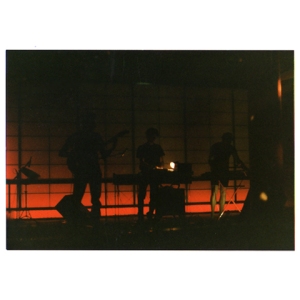
My musical history is brief but colorful. Many years ago, I was in several non-entity bands (translation: no gigs) before hooking up with a couple of friends in the late 1980s (no laughing, please) to form a trio devoted to, basically, weirding people out. We wanted to make good music, to be sure, but it was a pretty dead time around the city, so our main purpose was to try to shake up the scene a bit–to inspire others to do weird things too. We were a fairly electronic outfit – synthesizers, drum machines, and myself on both of those plus guitar and – after a fashion – vocals.

We weren’t that great, but we weren’t bad either. The important thing is that we were unpredictable. We were able to get shows, I believe, because the venue owners were curious to see what we would do. That, and we played for free. In fact, at most shows we lost money. This was because we were intent on producing a new experience at each one. New songs, new set lists, and some new visual twist was necessary for each show.

Untitled-1-(2)

Curari – Kansas City

Our shtick was video. Not many bands were doing the video accompaniment at the time, but we were big fans of those who were – the Butthole Surfers in particular. So for almost every local show we either rented a 16mm projector or a video projector (those were new and expensive) and blasted the image from the back of the room up on the stage, or, after a while, deployed a series of thrift store televisions (plus, to my wife’s dismay, our actual living room television) on stage and hooked up to one or more VCRs through a ridiculous array of wires and video splitters.

We started out showing stock films from the university library. I kept checking the same films out with a cool professor’s permission, and they hated me for it, because they knew I was lying when I said it was for research. My favorite was one called “Making Metals Behave”, which had lots of cool footage of flames and molten metal bubbling in huge smelters. By the end we were producing our own twisted videos using old black and white TV cameras we somehow picked up from a local theater.

Anyway, that was then and this is now. I’ve always kept up with the guitar, and recently got into some computer recording equipment. The result, with a little help from my friends, is Not Johnny.

Not Johnny is evolving, and that’s what I like about it. There is absolutely no pressure, so I am just going with what feels right. My first several songs, which I got very excited about, showed all the symptoms of enthusiasm married with impatience. That is, a few were good but some were not – I was anxious to package up an “album” to show off to my friends and musical correspondents.

But more recently, I’ve been refining the sound into what, for lack of a better explanation, Not Johnny wants to be. And I find that Not Johnny wants to be part swamp rock, part instrumental experimentation. I think it’s a good mix (but then that’s me). And, getting back to where I started, I find I am most comfortable and most “real” when following Ezra’s bedrock axiom. the songs I’ve posted here today, I think, illustrate my embrace of that philosophy.
Crossroads was written in a hurry, then recorded one lazy, Guinness-inspired Sunday afternoon with my good friend and collaborator, King Dick (of local fame and a consummate musician of the old school variety).

The goal there was to make something simple – almost traditional – on its face, but with a complex arrangement that belied that same simplicity. I’m pleased with it, because I feel I pulled that conceit off. You can listen to it in the fashion of some CCR swamp dirge, with a steady and unchanging backbeat and bare-bones vocals, or you can listen to the interplay of guitars (3 of ’em) and the King’s harmonica to hear the complexity of the interwoven rhythms and melodies – simple alone, somewhat complex together. Constant and variable.

Loss2: Elegy is actually intended as a follow-up tune to a song called Loss Leader (which I’ve also included). Here the idea was to pair a very steady, 3/4 rhythm (unchanged throughout!) with two layers of guitars playing the same progression, but staggered, kind of like a round. This base simplicity is complexified with the two-part division of the song. It is basically split down the middle with the first “version” of the progression, which forms the crime (Jonestown) and the second version, the string section of which forms the elegy.

Enough talk. I hope you enjoy them.

Funky Sucks

I read the comics pretty much every day. It’s a good, brief escape from reality.

Some comics I can’t stand, but I read them anyway – I’m not sure why.

So I was talking to some folks about how particularly bad the strip Funky Winkerbean is. The problem? Nothing really happens. It’s basically a bunch of people moping their way through very mundane lives.

I am actually an aficionado of bad comics. There’s something about them. Funky Winkerbean belongs in the “truly bad” category – it’s too maudlin and pathetic to rise to the heights of the “so bad it’s good” category, which is where I place Family Circus. So my complaint is real in the case of Funky.

funky

I mean, as many have noted, there’s nothing worse than mediocrity. So if something is only “bad” in the sense that it’s commonplace and boring, then it’s really bad. But if something is truly, insultingly, unbelievably, surrealistically bad – well, sir, then it catches my fancy.

This describes Family Circus and, yes, Nancy to a “T.” Family Circus occupies a special place in the stratosphere of bad art, however, in that it operates under a pretense that it is entirely unaware of how bad it really is. Not to mention how unreal it is – no family – I mean not one – could live up the ideal of Bill and “Thel” (what is that, Thelma? Who is really named Thelma?) Keane. They are ideal humans – the kind who don’t exist.

As an aside, however, I do find Thel pretty hot in a matronly way, so tall with her round hips and ample bosoms. She telegraphs both motherhood and the (evolutionary) reason men are attracted to full-bodied women (because they can bare lots of healthy Billys, Jeffys, Dollys, etc.). Was this unintentional on Keane’s part? I think not.

And what of the kids? They are, in fact, indistinguishable from each other because they, too, are unreal. Real kids have likes, dislikes, and unpredictable quirks. These kids are all exactly the same in that the only thing they are concerned with is saying and doing things which adults are supposed to find “adoringly cute”. They are more akin to trained monkeys than human children.

There are many more ultra-bad strips. I’ll just stick to newspaper strips.

Luann

This is a patently bad high school strip full of two-dimensional, half-realized characters, all of whom are curiously unlikeable. It gets extra points for being badly drawn also – not “edgy” badly drawn like the phalanx of new Internet comic artists who can’t be bothered with anything beyond stick figures, but just a failed attempt at well-drawn cartoon figures. Extra creep-out points: the strip is concerned with the life of an adolescent girl, including all her boy-crazed yearnings, but it’s drawn by a middle-aged guy.

LousyLuann

Mary Worth

A sublimely bad comic similar to Funky Winkerbean in that almost nothing happens. However, it exceeds Funky in interest thanks to the unbelievably patrician personality of the main character. Mary is the light of reason surrounded by the chaotic darkness of human folly, and for that it actually makes pretty decent theatre sometimes. It gets bonus points for its unflinching dedication to the tradition of strip art – right down to the “radiating lines” coming off a person’s face when they’re shocked, surprised, or otherwise nonplussed.

maryworth

Rex Morgan

This strip holds the dubious honor of being the slowest-moving strip of all time. Slower than Gasoline Alley and Mary Worth combined – we once clocked the action in this strip at approximately one week in Rex Morgan’s world taking up no less than four months worth of real time. I’m not kidding. June (Rex’s wife) was on a week-long cruise wearing the same bikini (and oh, did she look good in it) for weeks on end. It was once three weeks between breakfast and lunch. This strip has the bonus of being very professionally drawn – and all the women under 50 are built, as my mother would say, “like a brick shithouse”.

rexmorganrigormortisDennis the Menace

What can I say? The strip used to garner a kind of weird interest due to the somewhat bizarre aging process of its creator, Hank Ketcham – who, it turns out, never much liked Dennis (the character was modeled after Ketcham’s son, who later in life resented being his father’s muse). The strip devolved into daily panels featuring not Dennis in the starring role, but the right-wing rantings of his crotchety neighbor Mr. Wilson. Rather than snakes and snails and puppy dog tails, the strip’s themes centered on the ridiculous tax code, the declining spirit of an old man, and the meddling ways of the U.S. government. After Ketcham’s death, however, the strip descended into the depths of newspaper mediocrity at the hands of a soulless writing “team”, a la Garfield.

DennistheBore

National Health

I’m still on the national scene. I’ll have to mix it up with more local color, I know, but for now I’m fixated.

I have been considering the arguments for and against the administration’s – and, somewhat by extension, Congress’s – plans for spending their way out of the recession. A scandal-hobbled and severely weakened Republican party is attempting to rally the conservative faithful to guard against the administration’s incremental “takeover” of the free market, their plan to “socialize” health care, their designs on “dismantling” the Bush tax cuts. I suppose to them, it looks like Armageddon. But to me it just looks sensible. I try very hard not to be partisan on questions of nuts and bolts policy, and maybe that’s impossible, but I just can’t see the problems. Here’s how they look to me, one by one:

Socialism and the end of free markets? Hardly – the economic crisis is certainly more complex than you or I can fully understand, but one thing is pretty clear: if our financial markets collapse, we will have a very much bigger hole to dig ourselves out of than if we can do something to prevent that collapse. And that “something” is a cash infusion to free up capital, loosen credit restrictions, and increase the so-called “velocity of money” to get spending and growth back in the picture. It’s not a long-term solution to our problems (see below), but it’s a way to avoid longer-term problems in the short term, if that makes sense. The short explanation is “Japan” – their “lost decade,” economists agree, was longer than it might have been due to very sluggish action by their federal regulators at the outset of their own economic crisis. Like our domestic free market stalwarts, they were squeamish about intruding on the mysterious mechanisms of the “invisible hand” guiding the financial system. The result was a shut-down of credit availability that slowed their economy to a crawl for many years. The government came in with money and loan guarantees, but late, and the damage took longer to undo. It’s fortunate, in a way, that our crisis occurred on Bush’s watch, and the first massive bailout was planned and conducted under his administration. It quiets the noisemakers a little, as they must acknowledge that this is not a “Democrat” thing. I for one believe Obama when he says he doesn’t “want” to be in the banking business – it’s a necessity for now. As much as we may despise the big financial players for their greed, recklessness and willful ignorance, before we can make any systemic changes we must shore up the system we are currently working under. In fact I agree that we need a second stimulus. The alternative could very likely be chaos.

Nationalized health care – I just can’t see what’s wrong with it. The best way to express this is to look at the preliminary numbers and to note the many examples abroad from which we can learn and plan. I believe it’s safe to say that in the U.S., we waste a lot of money when it comes to health care. How else to explain that among industrialized countries, we are first in spending but only middling in performance (according to many published reports)? That is, we spend – by far – the most per capita on health care, but we receive, in terms of health care access and quality, nowhere near the best product. Why? One obvious reason is middlemen and the exorbitant costs of health care administration, insurance itself, and drugs. It’s no secret health insurance cost is outpacing inflation by a wide margin. Why? Drug costs are also through the roof. Why? Perhaps the why is unimportant. If we can offer a public solution to compete with these monolithic insurance companies and hospital organizations, the very competition we want to protect will be served. Rather than crush competition, a public plan might force a highly consolidated industry to simply take fewer profits and reduce inefficiencies and redundancies. Would it be so bad, for example, if your local hospital didn’t have a two-story atrium, marble floors and an espresso bar? I guess the question comes down to whether health care is a “product” or, at a basic level, a “right.” In a nation as wealthy as this one, it can be both. The cost of the health care plan before Congress is roughly 1.5 trillion dollars over ten years. But if we look at the projections of what we will spend as a nation on health care without the plan – estimated at about 35 trillion over the same period (we spent a verified 2.4 trillion in 2008 and are projected to spend 3.1 trillion in 2012 and 4.4 in 2018) – that “huge” number doesn’t look so big. Furthermore, if such a plan forces private industry to compete, to force efficiencies in the system and to be satisfied with smaller margins, then spending that 1.5 trillion—or even more—may actually end up saving us all money. I for one think it likely. We just have to have the guts to go head to head with the health care giants. As for the giants, I don’t blame them for wanting to protect their golden goose. But I would be very disappointed in our public “leaders” for not going after a few eggs for the rest of us out of fear or, worse, because they are themselves  in the pockets of Big Medicine.

Tax increases!!! – I believe, if memory serves, that the decade or so of massive tax cuts for the wealthiest Americans was offered up by the Bush administration and defended by a sycophantic Federal Reserve as a “solution” to our economic “problems”. Well, here we are. Can we try something else now? The interesting thing is that as the economy has cratered under this philosophy, the very rich are getting – you guessed it – richer. In constant dollars, the gap between rich and poor in this country continues to grow. And the concentration of wealth in the upper echelons continues to concentrate as labor and the middle class absorb more and more of the tax burden. At last report, the richest 1% of Americans controlled 20% of the country’s wealth. We all know this. It’s not necessary to point out that these ultra-rich pay “more taxes” than the local McDonald’s manager (in terms of percentage and dollars). Of course they do, because they can afford it. Paying 46% of a 100 million dollar income still leaves you with 54 million, you know. And I don’t need to be reminded that they “risk” their capital to start businesses, create jobs, etc. Of course they do – because with risk comes reward. And – a very important point – they have the capital to risk in the first place. Do you? You work hard, don’t you? You “invest” as much as you can – in the market, your 401, Beanie Babies, whatever, knowing your investment is at risk. And yet – gosh – you are still taxed. How come? The answer is pretty clear – because you (and I) don’t write the tax laws. It should be crystal clear by now that trickle-down economics is at best a fantasy and at worst a form of theft. Give the super-rich more money, and they put it in the bank. They don’t spend it (because they don’t need it). Or, worse, they lend it back to the government at attractive interest rates to allow the government to pay its debt – debt it has incurred because it does not collect enough taxes. Which creates ever more debt. This really happens. It’s not the rich people’s fault – they’re programmed to make money, they really can’t help it. And within reason that’s a good thing. But the cycle we’re in is not good for the rest of us. So it’s up to government to equalize the tax code already – and by equalize, I mean ask those who reap the greatest rewards from this economy to contribute the greater share toward its maintenance, until we have equilibrium. Heck, some of them (notably Warren Buffet) are themselves asking to be taxed more.

But what it really all comes down to, I and many others have been thinking, is what we value as a people. The familiar refrain during this recession is that the only way out of it is if Americans “start spending again,” as if only the working and middle classes can save us by buying a new TV. I can see how this helps the TV manufacturer and Wal-Mart – but how does it help the rest of us? Americans, it seems, are going exactly the opposite way. They are buying less expensive things, and fewer things, and smaller houses, and “staycations”. They have started thinking about what they buy, rather than buying out of habit or from advertised coercion. They are, in a simple word, simplifying. They may even find they like it. I have found, even though I like the possessions I have, that too many possessions is not a blessing but a burden. They just weigh you down.

So how do we save the economy? Maybe by spending – but not on TVs. Maybe we spend on better health care access for everybody (a net savings due to increased wellness), better roads and bridges (which will need building anyway), more efficient energy systems and factories and appliances and cars and homes (also a net savings and a balm for our abused environment). We should spend on outreach and assistance to Africa and to our so-called “enemies,” spend on alternative energy research to reduce our consuming addiction to their natural resources (which is how they became “enemies” in the first place) and in so doing de-fuse their own leaders’ anti-American rhetoric. In short, instead of buying a TV, let’s buy a sustainable future. We can simplify our material life and invest instead in our national and global health – in every sense of that term. It is a short-term asceticism that may well bring forth a long-term flowering of our nation and culture into what it always had the potential to become: a nation of progressive, fair-minded, egalitarian individuals working both for ourselves and for the common good of our fellow citizens and the world. It’s not impossible if we just decide to do it. The only obstacles I can see are greed, paranoia and cynicism. I don’t know about you, but I’ve had enough of that.