Undici Quarantacinque

It doesn’t matter where you go, or how long you stay. When you return from a trip, you bring back both memories, which are temporal, and  impressions, which are ethereal.

Or so it is with me. For now I can roll the experience like a movie in my head, from start to finish, and remember most of what happened. That’s the memory, and it will fade. But I also have the impressions, the all-senses recordings of a moment, or a place, which I know I will carry with me forever.

With regard to Florence, I’ll now have two sets of impressions, and two faded memories. Of the impressions from my childhood visit, I spoke somewhat in my last essay. But specifically, there is the fried potatoes at the little Trattoria we found quite by chance one evening. I remember my father, mother, sister and I had been wandering around aimlessly in our characteristic way, probably searching for the cheapest of the restaurants, when we finally stumbled into one, literally a hole in a wall – the door was broken off its ancient hinges. It had about five tables, with Mama doing the cooking and Papa working the tables. I was a bit intimidated by this place, its earthiness, but I knew what I wanted: French fries. And by chance he was willing to make them, what are known locally as patati frita. I ordered them, and ate them with salt and a little wine, and they were the best thing I had ever eaten in my life. I think it was the olive oil.

So I suppose it was the sensory memory that created the lifelong impression of those French fries. At any rate, I know I’ll never forget them. Nor will I forget the greasy face of that hard-working owner, stooping over my chair, peering inquisitively into my greasy 12-year-old face stuffed with fries, saying with a twisted grimace that may have been merely questioning or may have been a little challenging – “e bene?” I was satisfied the place was not dangerous, comfortable with my wine, and knew enough Italian to reply with gusto: “Molto bene. Benissimo.”

This seemed to please the old man. He had impressed the Americans. (I should point out that in the early 1970s, American families strolling aimlessly around Florence was not a common thing. We were like Bigfoot.)

And this year’s trip – I know for a fact I will never forget the Uffizi man. The Uffizi man had what I consider the most stressful job in Italy. It was his task to stand outside the Museo dei Uffizi – one of the most visited museums in the world – and try to manage controlled entry for a frenzied crowd of over-scheduled, over-stimulated, reservation-holding art lovers.

It must be understood that in Europe, people do not necessarily queue up for entry into a place the way they do here. They more or less bunch up around the entrance, forming an organic blob of people with no beginning and no end.

These days at the Uffizi, the non-reservation entrance is a blob of people about half a mile long at any given time (in 1974 we just wandered in). The usual wait to get in is about two to two-and-a-half hours. But for those in the know, there is a special entrance for timed entry. You simply call a few days ahead, book a time of entry, and they give you a reservation number. You show up at the reservation entrance at that time and avoid the big blob of tourists in the regular line.

Still, it’s a harrowing experience. The people still bunch up, fearing they will miss their time. So about 75 people or so–those who are on time, a little ahead of time, or a little late–are all standing there, pushing toward the door, waving their reservations at the little old man standing behind the velvet ropes that guard the door to Botticelli, Leonardo, Titian, Michelangelo, Rubens and the rest.

He is about 60, or maybe older, aristocratically thin, short from an American perspective, careworn, with a big blue jacket, fashionable pants and shoes (he’s Italian) and a good head of silver hair. He looks about himself, rarely into the eyes of his supplicants, but beyond and a little above them, as if he’s waiting for some superior force to come and make them all go away. He answers his cell phone and cups his other ear to hear over the crowd. He stands behind the ropes which only he may touch. He lights a cigarette, smokes it hurriedly, then stubs it out after a few puffs. He points to his watch, he shrugs his shoulders, he listens to plaintive stories in Italian or French, answering back in tones of regret, of pragmatism, of powerlessness. But mostly he says, in a loud but not hostile voice – more a plaintive one – the time. He announces the time, like some town crier, at fifteen minute intervals.

“Undici quarantacinque,” he says. 11:45. That’s our time, all of us. When he says it, we wave our little slips of paper and, like good Catholics, chant the responsorial song: “Undici quarantacinque! Undici quarantacinque!” He nods knowingly, waves his arms to take us all in, his 11:45 flock. But then he shakes his head, points to his watch. Not yet.

“What time is it?” I ask my wife in a too-frenzied tone. She is calm like the Arno. “It’s only 11:35.” “Oh,” I say, “it really seemed like it should be time.”

“Undici trenta?” The man says to anyone who may find wisdom in the statement.

All of these people, including me, are thinking the same thing. They’re not sure how the system works. They’ve planned for months, come from far-flung lands, spent a fortune, with the Uffizi as their main object. They have a reservation, but what if they never get recognized by the little man? Occasionally he opens the magical ropes and lets a few people in. He has inspected their reservation. They must be a little late, I think. They must be undici trenta – yes, I’m thinking of time in Italian now. It just seems more efficient.

I am staring at this man as one would stare at a judge empowered to suspend an unjust life sentence. He is good at his job, he does not acknowledge me. He looks at his watch. I look at my watch. The crowd surges, it – as if evolved into an organism – is getting impatient. I’ve been at the front too long. Like cellular waste in the amoeba, I will be sucked away from the nucleus to the edge of the crowd creature and disgorged.

People yell from the back – “Dodeci!” Twelve noon. They are a million miles away. Just stay the hell away. The man shakes his head, waves his arms around our now intimate group – the in crowd – the undici quarantacinque crowd – and says it with polite resignation: “Undici quarantacinque.”

Hours seem to pass. Suddenly he looks right at me. He says it out loud, “Undici quarantacinque,” with a finality in his voice, a beautiful fatalism, and I, gripping my wife’s hand, surge ahead, realizing our time has come. The rope comes off its hook, and I thrust my little scrap of paper into his face, and he inspects it and nods his head resignedly. We pass beyond, through the ropes, the glass doors, into the lobby, and head toward the ticket window. I am ecstatic. I’ve done it. Four thousand miles and I’m here. And it will be fantastic.

And as we enter, I hear in the background, faintly now, that voice: “Undici quarantacinque…undici quarantacinque.” And I always will.
The Nose of the Boar

My wife and I just returned from a week in Italy, Florence to be exact.

This whole thing started by planning a run-of-the-mill trip to San Francisco. It was last September. I was on the Web, checking out fares and accommodations, getting a line on some pretty good deals. Then I started thinking about it. What, exactly, were we going to do in San Francisco? We could visit some friends and relatives, maybe see an art opening, but in fact we had already seen all of the “sights” on our last trip there. And in truth I had no great desire to go back.

Then I started thinking, “Well, then, where do you really want to go?” And I knew right away it must be Florence.

I had visited Florence once before, when I was a lad of twelve. My family was living in Naples at the time (a great place to live, but you wouldn’t want to visit there). We drove up to Florence for a two or three day visit.

When we got there I was immediately blown away. The city itself is a work of art. The narrow cobbled streets, the ancient buildings, the winding Arno and its beautiful bridges, all surrounded by the rolling Tuscan hills. This is the city of the great Medici, the city of the Renaissance. Here is Brunelleschi’s famous dome for the cathedral of Santa Maria del Fiore (AKA the Duomo). Here is the Uffizi, the greatest museum of the world (with the added feature that it is not in France). Here are dozens of important basilica, cloisters and cappella. Here is the home of Dante, of Galileo, of Michelangelo. Here is the birthplace of modern art and science.

Of course, I didn’t quite see it that way at age twelve. But I knew I was in a magic place, a place that exists outside the mundane world of office towers, malls and suburbs. I knew the streets were for walking, and that the cafes were for idling, and that the people were alive to it all. I saw Botticeli’s Birth of Venus and knew I was in the presence of a masterpiece. I drank wine in a family-owned Trattoria and strolled to the Mercato Nuovo, an open-air market famous for leather and stationery, where I rubbed the nose of the boar.

And in truth, that was it. I had forgotten, until some days after I had convinced my wife that Florence was our destiny, after I had booked the flight and the townhouse, after I had checked out my Italian language CD from the library–I’d forgotten that on that chilly night in 1974 I had in fact rubbed the nose of the boar at the Mercato Nuovo. The boar in question is a large bronze statue of same, one of the several symbols of Florence. Its nose is kept perpetually shiny by the hands of a thousand tourists a day, all of whom know that a visitor who touches the nose of the boar is guaranteed to return to Florence one day.

As I did. And I am forever thankful to that boar.

Merry Christmas – Happy New Fear

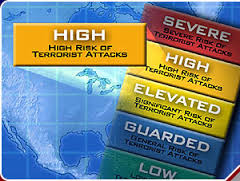
I very much would like to tell Tom Ridge what he can do with his orange alert.

I guess it’s just not the Holidays here in the good ol’ US of A anymore without a healthy dose of fear courtesy of Uncle Sam. Just when you thought you could perhaps relax a little, shift the weight of the world from your shoulders a little and take a small amount of comfort in what remains to you in this fractured, soulless society – namely, family – along comes our beloved, rumor-mongering officials with yet another cry of wolf, another announcement that the sky is falling, another whimper into the pillow.

orange

Eventually they will be right, just as I would be if f I step outside every day and say, “Today it will rain.” But that doesn’t make what they are doing right. On the contrary, they have already squandered their stock of credibility on the parade of orange alerts that have come and gone with no disaster. Their message may be an authoritative warning in their eyes, but to me and everyone I know it is heard as a pathetic excuse for a spectacular failure to fulfill their mission to protect this nation.

When Tom Ridge speaks, this is what we hear: “We are incompetent and impotent in the face of this small band of loosely organized thugs. After all, we’re just the United States of America, but these guys are fanatics with e-mail. They frighten us. Aside from announcing the coming strike, there’s really nothing we can do except await the next blow from these half-mad, unarmed, rag-tag outcasts of society. Because despite a $400 billion defense budget and the combined resources of the wealthiest nation on earth arrayed against them, they remain one step ahead of us at all times. After two years on notice that they are out to destroy us, we continue to scratch our heads and wonder what to do.”

Here’s the tally on the U.S. versus al Qaeda:

  • They attacked New York and Washington, so we attacked the Taliban
  • They remained a threat after the Afghan war (because we let them run away), and Osama remained alive, so we attacked Iraq

We know where the leaders are – always have known – but even though they have no arms to speak of, no tanks or missiles or even significant numbers of men, we can’t go get them. The reason? Simple – they are in a “lawless mountain” region. Again – $400 billion a year, the most sophisticated equipment in the world, half a million soldiers – but we just can’t hack it in those mountainous, lawless regions. So we wait for them to strike us again.

But in contrast to the fatalistic hand-wringing of Tom Ridge, at least we have General Myers, chairman of the joint chiefs of staff, who the other day provided us with this confidence-inspiring analysis in the press:

“There is no doubt, from all the intelligence we pick up from al-Qaida, that they want to do away with our way of life,” he told “Fox News Sunday.”

“And if they could use another catastrophic event, a tragedy like 9-11; if they could do that again, if they could get their hands on weapons of mass destruction and make it 10,000 (deaths), not 3,000, they would do that.” (my emphasis)

So, for reasons that can be known only to himself, General Myers has in effect handed our enemies the recipe for victory against the United States. Myers–the supreme commander of U.S. military forces–either believes that we cannot withstand an attack of such magnitude and will crumble, as a society, in the face of it, or he is simply thoughtless enough to appear to say so to the world.

It’s unfortunate–Myers probably meant merely that “they would do that” (kill 10,000) if they had the means, not that “they would do that” (succeed in doing away with our way of life) if they could pull such a thing off. But it’s too late now to clarify. The gaff–the latest of so many–belongs to the spinners now. In the East, it will be interpreted as the former, not the latter.

But in light of the season I close with unequivocal words of wisdom: Peace on Earth, good will toward men.

Snow Falling on Laws

Snow falling again – the second time in a week. It hasn’t been much snow, but it’s bitter cold as well, so no picnic blowing it off the walks and driveway. I’ve been battling some bizarre illness the last few weeks, which has me very tired and lazy, and so I haven’t done as good a job on it as usual. I tromp out there in the evening and blow off the cement, but it keeps snowing, so there’s a new thin layer there by morning. And no way am I going out there in the dark of morning to blow snow. I see my neighbor out there plowing away, doing his duty as I’m guiltily pulling my car out into the uncleared mess, smashing down the snow on my driveway into ice and leaving the pedestrians to the whims of fate on my snowy sidewalk. But It’s just not in me. I hate that morning cold.

What I’ve been thinking about is the idea of decisions a society makes–or fails to make–as it stands on a threshold between what it was and what it will become. We have a few of these flitting around lately, mostly involving the rule of law versus the chaos of human nature. And no, it’s not clear which is better.

In fact human nature was all we went by for millennia, and for sure it resulted in some major atrocities. But after several hundred years of societies supposedly founded on laws, the atrocities continue. War itself is like a “time out” from lawful rule. Normally, it’s a big no-no to slaughter children. Individuals who do it are “monsters” whom we routinely put to death. But we, the U.S., a force for good in the world, now routinely launch weapons into our proxy “battleground” countries (Afghanistan, Iraq) that we know will kill innocent children. The only difference is we’re not intentionally targeting them. But it doesn’t change the knowledge that it will happen. And it’s OK because it’s war. And in war there are unforeseen casualties and, that most meaningless of euphemisms, “collateral damage.”

So people like me have to qualify an idea like “rule of law” with an undeniable knowledge that the rules are routinely broken by states that find them inconvenient. It is argued in high circles that nations retain an “escape clause” from codified laws–such as those prohibiting mass homicide–when they find it necessary to act to protect their own existence. In other words, in self defense. So each act of belligerence these days is carefully couched in the rhetoric of defense–we are merely defending, if not our actual sovereign land, then “threats” to our safety or our “vital interests” in other lands. We now launch unprovoked attacks that we know will kill innocents by the hundreds, if not thousands, because someone in those lands “might” be plotting something against us.

We decide to be a nation of laws, and this is perceived as a good thing. Because the high emotions of the lynch mob or the oppressive majority are supposedly held in check by a code of allowed and proscribed behavior, we can say we have an orderly society. But I submit that we have stretched the “escape clause” definition to an extent that ambition, or thirst for power or revenge, or mere political gamesmanship are too easily masked as “defensive” grounds for mass killings of the world’s surplus people–whose only fault is that they were born in backward countries, in chaotic times, in a world devoid of the rule of law.

We need to define our nation’s acts as they are actually wrought, so that we might embrace our future as a nation of warmongers, or reject it and pursue another course.

Close to Home

I generally take the same route each time I walk the dog. It’s a circuitous route around the neighborhood, chosen for its flatness mainly, and its relative lack of yard dogs.

There is one black dog who never barks at us. I’ve been walking Emma by him for too long. He just stands and stares at us. Not a friend, really, but a neutral party anyway.

It’s a comfort, this wind of familiar streets and sidewalks in the evening. Nothing exciting, but at least I know where I’m going. And the black dog knows me.

I bought a camera recently, an older Japanese SLR – super manual. Got it pretty cheap. I’ve been trying to learn how to use it, taking a roll of shots pretty indiscriminately, testing shutter speeds and apertures in different light.

Of course you get a nice camera and you think you’re going to become the next Ansel Adams. Then you start looking at your daily world through the lens and realize it’s not very compelling subject matter.

But I do go places. We actually have quite a large collection of snapshots from our travels, our celebrations, and such. In about a month we’re going to Italy, which is one reason I decided to try to make the jump to a better camera.

I want a better chronicle of my life. That’s also the reason for this site.
But it’s been, the past few weeks, one of those periods where not much happens. We had Halloween, and my daughter chose to be something “scary” (vampire’s wife) for the first time. It was quite fun, with a pizza and, later in the evening, old horror movies with a few friends.

And of course the world keeps falling apart, nothing new there. The best lack all conviction, etc. They keep picking off our boys in Iraq, one or two a day like there’s a quota. The other day they blew up a bunch of Italians, just for good measure. George Bush is going to London this week. Our only remaining “ally” is beefing up police presence for the visit, bracing for “the biggest mass protest in modern history,” as they are predicting it. It must be great to be completely oblivious to condemnation from the entire rest of the world.

I’ve been suffering through a new ailment, a bum foot. I can not tell you what happened, only that all of a sudden it became very painful to walk. It’s been getting better with some care in walking (Maybe another reason my life is slowed down these weeks – can’t walk too far.)

Maybe this weekend we’ll drive out to the small town we visit each fall . It’s a quaint little place, with apple orchards and a fine old park with ancient trees and an old mansion you can tour through. Maybe we’ll get a good shot of my daughter in the colorful leaves for the old Christmas card.

A man could do worse.