Socialism Part 2: What’s in a Name? Plenty.

The first step in the process is to reclaim the validity of the word “socialism.” American conservatives – capitalists by nature – have done a good job of transforming the word into a pejorative. For that matter, they’ve made good progress on the term “liberal,” as if the very concept of being open to new ideas and new approaches is anathema to our buttoned up, top-down economy and its trans-national corporate masters. Also not coincidental, the nation’s approved history textbooks barely touch on the popularity of socialism among Americans in the 1930s (with the Great Depression marking the first object demonstration that the Dow Jones is a measuring stick for the elite’s finances, not a system of governance for all of us). Of course, the end game of America’s flirtation with socialism and communism in the 1930s was Joe McCarthy’s House Committee on Un-American Activities (HUAC) and the great communist witch hunts it set off in the paranoid post-war 1950s.

Now the Great Recession has reminded us, once again, that the big risks of our economy are being borne not by ultra-wealthy “job creators” but by the 99.99 percent of us who do not own the world, its resources and its governments. When capitalist deal-making hits pay dirt, oligarchs get richer. But when it goes bust, as it did in grand style in 2008, strapped taxpayers foot the bill in the form of tax write-offs and bailouts. Then, as a final insult, when the government needs more money than the GOP will let it collect in taxes from billionaires, the government borrows it from – you guessed it – these same billionaire tax dodgers, who prefer to make interest on the money they “lend” to Uncle Sam. This is known as “privatizing gains and socializing losses.” Americans are picking up on this pattern, and they do not like it. The natural question that should come to our minds is, “If corporations are going to get the taxpayer-funded benefits of socialist policies, shouldn’t we taxpayers be eligible for them too?”

But as the options for choosing leaders dry up — as our politics gets deeper and deeper into the gutter, scaring off decent people who want to help — those who vie for office all appear to be variations on the same gladiatorial theme. Politicians are being molded by corporate interests, at corporatized universities, by special interest “AstroTurf” groups like ALEC and the NRA, and by corporate “think tanks” like the Heritage Foundation and Club for Growth. They are producing politicians the same way McDonald’s produces managers at Hamburger University—absorb the corporate philosophy, preach the corporate philosophy, defend the corporate philosophy, and project a belief that there are no viable alternatives to the corporate philosophy.

Except that it’s not a corporation—it’s my government, it’s your government, it’s our government, and it should work for all our interests.

Socialism = Despotism?

As an option for governance, socialism’s biggest hits came from those 20th century revolutionaries who overthrew their monarchies or oligarchies and put in place severe, ideological, paranoid, oppressive regimes that were called (naturally) “socialist” regimes. So for Americans who are not curious enough or creative enough to wonder how else one might implement a socialist system of governance, the only working models are the totalitarian regimes of Mao, Stalin, Kim Jong Il, and the rest. Worst of all from the American perspective, the “Union of Soviet Socialist Republics,” what Ronald Reagan famously called the “evil empire” – this evil empire was our object model for conceptualizing socialism. We perceived socialism through the prism of an anti-socialist, pro-capitalist society.

Now, as in the 1930s, people are waking up to the reality that a blend of our Democratic principles with Socialist monetary and regulatory policies may – that is to say it just might – be preferable to a system run by a cabal of self-interested billionaire families, a system that works for the benefit of roughly 0.01 percent of the population. Yes, it might be better than the oligarchy our current “democracy” is creating.

Next: Democracy on a Ventilator

Growing Up Socialist

Based on my upbringing, it’s almost impossible that I would turn out to be anything other than a card-carrying socialist. This truism would make my father roll over in his Arlington National Cemetery grave, I suppose. But he – as an intellectual – would also have to agree with my reasoning.

Dad was a South Omaha Polish Catholic boy made good, graduating from West Point in 1958 to embark, along with his new wife (and my mother), on a globe-trotting career in the U.S. Army. He was a career man, with two tours in Vietnam attached to an SVA (South Vietnamese regular army) unit, a Signal Corps officer who retired at the age of 45 or so.

This means that as a child I also traveled the world, often living on federal property, and was essentially raised within the U.S. Army culture. It is a 100% socialist culture.

In the military, everyone has a job. Nobody is starvation-poor, and nobody is mega-rich. For 2016, the Army pay scale lists the lowest private at about $1600 a month and the biggest, cigar-chompingest four-star general making about $19,700 a month. That’s a difference in pay, between the lowest-paid grunt and basically the CEO of the Army, representing a factor of 12.3. Compare that to someone at Wal-Mart making minimum wage ($1,200 a month) and the Wal-Mart CEO making, let’s say conservatively, about $1.5 million a year or $125,000 a month. That’s a factor of 100+. (Top-earning CEOs make $125,000 an hour. Side question: how does one “earn” $125,000 in one hour? How is one person’s “labor” equal to the labor of 17,000 minimum wage workers?)

In the army, as in a classically imagined socialist society, there are “party members” (officers) and the “proletariat” (enlisted). Officers “run things” (executive) and the enlisted “do things” (labor). The executives get better pay and more perks—they have college degrees and undergo extensive educational training (War College, Command School), not to mention the added responsibility of being in charge. But those in the ranks of labor are provided for as well – in addition to base pay the enlisted soldiers in the barracks eat for free, have free housing, and free uniforms. (Officers pay for most of these things unless deployed in a war zone.) Yet everyone is guaranteed vacation (30 days a year last I checked) and sick leave. And if you get really sick, guess what? You’re covered, because health care is free. Provided you make a career of it, a soldier gets free medical care for life, plus a fair pension after twenty years of service. (Right now the pension is 50% of the soldier’s highest average 36 months of pay, regardless of rank, and this is in addition to Social Security retirement benefits.)

Everyone is covered. There are no homeless, there are no “illegals”, there are no charity cases, there are no elderly workers left high and dry by raided pension funds or crappy 401K plans.

Because of the “uniform” quality of life in the military—nobody stands out, nobody is singled out for special treatment—the military has largely marginalized the effects of American racism and classism in its culture-within-a-culture (except for the traditional, generalized class differential between officers and enlisted). Obviously these effects cannot be entirely eliminated. But as folks like Colin Powell have shown, a black soldier faces no institutional barriers to success in the military. He or she can get all the way, as Powell did, to the very top. You don’t have to come from any particular family or go to any particular school. (West Point helps, but again, anyone with the chops to succeed there is welcome. There’s no tuition—students get paid—and of course room and board are free. And you have a good job the day you graduate.) As you may recall, the military was even out ahead of the rest of American culture on gay acceptance. Women, in a culture invented for men, have had a rougher road, but they too are progressing. The army just graduated its first two female Rangers last year (both West Point graduates).

It’s simple: an egalitarian culture promotes and nurtures egalitarianism in its members, who feel a natural sense of dignity, of being respected within the culture no matter their individual role. Regular soldiers, not generals, tend to win the highest of military decorations. Most enlisted soldier’s I’ve known regard officers as “different” than them in their career path, not “better” than them because of their rank.

Of course, the U.S. military is an artificial culture in that, socialist as it may be, it is completely dependent on the greater American economy for its continued existence. The military is not an economy, it does not “produce” anything (aside from abstract “security”), it only consumes tax funds. The U.S. military is not the answer to our struggles with corporatism/oligarchy, but it does serve as an object lesson in how to build a fair and equitable societal structure, one in which all can thrive and all can live with dignity. We can learn from it.

Why Now?

It feels like I could have written this item a long time ago. Maybe, because in my past the word “socialism” was roughly equivalent in the American lexicon with terms like “godless communist” or “evil empire,” I felt like it would be a wasted effort. I mean, I think I’m pretty safe in arguing that before 2016, no socialist of any kind could have expected to be nominated for the presidency, let alone occupy that office.

And maybe that’s still true. At this writing, the bean counters expect Hillary to win the Democratic nomination this summer despite the extraordinary grass-roots popularity of her Democratic Socialist challenger, Bernie Sanders. She simply has the math in her favor, and – not incidentally – the party apparatus and its many veteran Democratic voters.

But the phenomenon of the nation’s young people “feeling the Bern” and coming out for the man in huge numbers looks like a harbinger of a new direction for America. It feels as though the dismantling of the oligarchy may come, if not next year, then soon—regardless of who wins the next presidential election.

Next: What’s in a Name? Plenty.

What is Trey Gowdy Waiting for?

Congressman Trey Gowdy runs the 5th annual select Congressional Witch Hu..I mean Committee on Benghazi, otherwise known as the Stop Hillary At All Costs Committee. With all due respect to Benghazi, and those 4 dead people, the committee’s real interest has been in either finding or fabricating a “smoking gun” that would let the American People know just how much the GOP hates the former First Lady, Senator and Secretary of State. Gowdy says, “Just wait…we have big news…” This was several months ago, after Clinton handed the Committee’s GOP members their asses in her now-famous “eye roller” appearance before them. Since then, the FBI has been carefully gathering its “evidence”, but we hear nothing else from the group.

Now I get it. Gowdy is waiting for the primary results to shake out. If Bernie gets the nomination they can just sit tight and let the Koch’s $900 million worth of “Honeymoon in Russia” ad buys do their work (look it up), along with every right winger on the planet laser-focused on message: “America is not a socialist society. Capitalism is our way of life.” (Here’s the ad: slo-mo images of sun-kissed Old Glory waving along with fields of grain and kids playing baseball, affluent grandpa serving up a turkey a la Norman Rockwell – meanwhile the concerned motherly female voice-over – “America was built on the spirit of independence and personal freedom, where anyone can strive to realize their dreams. Do you want your grandchildren to grow up in the good old USA?” – images now abruptly switch over to slower-mo Hammer/Sickle overlaying Bernie’s angry-looking face, red flags waving in a barren field, gray drab room full of angry-looking brown-uniformed bureaucrats scowling at the camera – motherly voice becomes ominous now “…or the (big “Soviet” block letters cover the screen) USSA? Vote Ted Cruz in November. Vote for freedom.” Cue GOP landslide.

But if Hillary wins – what then? Hillary isn’t a commie. Simple. The day after she takes the nomination, announce her indictment for crimes against the United States. What crimes? Well, passing on classified e-mail on a non-secure server is plenty for them to work with. Sure, it’s not really that big a deal, and she probably couldn’t have realized the stuff she received in her In Box would later be classified, or in a couple cases already was classified, and at bottom some 99% of classified stuff is unnecessarily classified, and a conviction would be difficult to get. Sure. But the law is the law, and politics ain’t beanbag, and $900 million is $900 million, and every minute she’s under indictment she’s vulnerable, distracted – and losing.

This could well be the strategy behind the current lawlessness of the Senate majority, refusing to perform its duty under the Constitution. Why bother with Obama’s Supreme Court nominee when the White House is a lock?

On the plus side, I still don’t think it will work. I’m beginning to think the woman could go 15 rounds with Sugar Ray and not even take a corner.

Bern the Witch?

It’s convenient for Hillary haters that she’s a woman, because in this society a woman has a much higher bar to acceptance as a political leader than any given man, and especially an old white man.

You can’t score political points against Bernie or even Trump by insulting his clothes, his wrinkles, his thighs, his ass or even his crazy hair (ahem, Trump?), or really any personal attribute. No, the political effectiveness of these “attractiveness” insults is reserved for the female candidates alone. Or, as we’ve seen lately, it may also be deployed against the wives of male candidates, for whom ugliness or (God forbid) overt sensuality is the ultimate political crime.

In fact, a study I was just reviewing showed that many Americans tend to start with “distrust” of any woman who seeks political power or even asks for their vote. Sound familiar? If you think you’re a progressive, think for a minute more why you “hate” Hillary so much more than Bill (still one of the top-rated politicians in the country), or why you’d rather have a disastrous Trump presidency.

Bill I find it telling that so many “progressives” (that word is now dead by the way) who said little against Bill Clinton when he was in office (maybe because they had good jobs?) now reflexively blame his wife for everything bad that happened during his administration. Yet at the time, she was excoriated (and kicked out of the process) for being a “buttinsky” First Lady – you know, trying to help reform Health Care, which apparently is a man’s job.
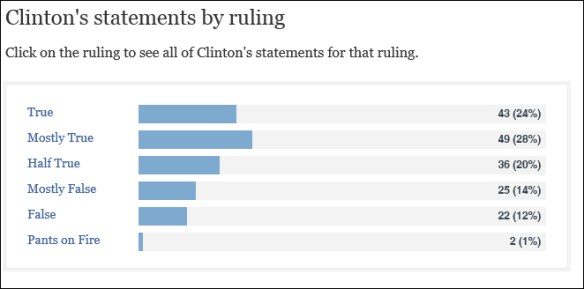
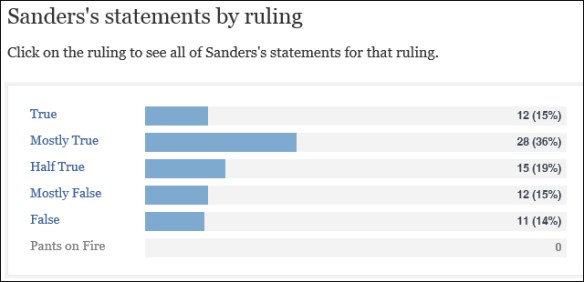
Also interesting that the word “liar” is being tossed at the candidate with such cavalier abandon. I would read your propaganda links, bro, but it’s easier to check Pulitzer Prize-winning Politifact, which confirms that Hillary Clinton has the best honesty rating of any of the candidates, including Bernie Sanders. Oh, yeah, that’s “mainstream” info – “establishment” data. Probably rigged, like every single Democratic primary, all the vote counts, all the delegate counts. All rigged. Have you bros thought of forming a Progressive Tea Party? As conspiracy theorists, you will have more to commisserate about with them than with Democrats.

Hillary Bernie

Sorry none of this fits into the political purity/socialist paradise narrative. Life is funny that way, and there’s no such thing as political purity. Go ahead, back your candidate. Please – concentrate on that. Personally, I think Bernie would be an OK president, but it’s hard to say since all I hear from his supporters is how criminal everybody else is. I have no interest in trashing him, since he’s a legit candidate. His backers deserve their voice and their shot. But if anyone can whine, the Democrats would seem to have more of a right to complain about election hi-jinks, since Sanders is not even a member of the party he’s attempting to take control of. But notice – they don’t. They are not screaming epithets at Sanders as if he’s some kind of evil monster. They are grown ups trying to let the process work.

In any event, I’d think twice before making a sexist fool of myself in pursuit of the nonexistent ideal and highly unlikely “revolutionary” change being promised. (Remember “Hope and Change?” There’s this thing called Congress…they don’t play nice.)

The only reason to fear women in authority is a kind of insecurity you guys probably don’t want to be known for.

You Down with TPP? Why not, G?

I’d be interested in hearing concrete arguments against free trade agreements in general. I am not sold either way, but it’s not material for someone to say the TPP (for example) is a “job killer” or “wage killer” or whatever, unless it is explained exactly how that will occur under the agreement in question. I get the concept – that free trade agreements mean transnationals can move production/labor to the “lowest bidder” on wages and conditions. The notion is, this drives down wages and working conditions to the “very worst” acceptable conditions that the international labor market will bear.

Definitely not desirable! But it’s not helpful to condemn free trade for these theoretical “bad” outcomes without also examining the alternative, and how “good” those outcomes will be. The alternative to free trade is protectionism. Possibly Trump’s biggest appeal, and a major appeal for Bernie, is in promising new protections for American workers in the form of tariffs on foreign goods. What do tariffs do? Well, they are the opposite of “free” trade, so what they do is restrict trade. For example, the U.S. places a “burdensome” tariff on cheap Chinese auto parts – these auto parts become too expensive to buy in America, so the idea is that Americans will now buy the American-made auto parts and support American workers rather than Chinese workers.

Well, heck, why not?

Under pressure from the flagging domestic steel industry in the 1980s, you may recall, the U.S. slapped tariffs on Japanese steel imports. The American industry had been in a steady decline, largely due to inefficiencies in process and wasteful management practices that drove up the wholesale cost of U.S. steel compared to competitors. The U.S. steel people painted it as Japan “flooding” the market with “cheap” steel. But the Japanese had innovated new, more efficient manufacturing processes, and could produce steel faster and cheaper than U.S. mills stuck in a “monopoly” frame of mind. Japanese steel was “cheap” but not in the way the industry implied. It was better, and it cost less.

We all know what happened to the U.S. steel industry. Far from being “protected”, only its outmoded production and management models were protected – for a time – until the world market dried up for (lower quality) U.S. steel. Japan could produce a better product for less money, so everyone bought Japanese steel and nobody (except Americans) bought U.S. steel. The industry collapsed in spectacular fashion.

But that’s far from the whole story. The modern world economy is not about widgets – it’s about innovation and adaptability, about supply chains and logistics, communication and coordination across continents. That’s just. The way. It is. No matter what American policy is or is not implemented, this truth will not change for the rest of the world. Bernie (and Trump if he had the wits) likes to talk about “thousands” of U.S. plants “shuttered” because of NAFTA, and “millions” of jobs lost. OK. But let’s examine that connection. Both happened – but is NAFTA the cause, or the symptom, of a worldwide global recession? When plants close, is it always the fault of some trade agreement that was struck somewhere? Of course not. Just look at the steel industry – it failed for the opposite reason, because the U.S. rejected fair trade and reaped the whirlwind.

And what about all those job losses? One would assume that if NAFTA and other trade agreements are the cause, then countries not engaged in free trade should be doing better. Except they’re not. A fact we should all memorize during this fact-free 2016 presidential campaign: the U.S. economy today is in far better shape than literally every other industrialized economy in the world.

Once again: the U.S. economy today is in far better shape than literally every other industrialized economy in the world.

So let’s look at Pittsburgh. Two decades after the final tolling of the bell for steel, Pittsburgh is resurgant, with a vibrant new economy centered on education and the service industry.

The point is there was no future for steel – but there’s a future for what Pittsburgh actually CAN do better than foreign competitors. And now they are doing it.

What’s more, all of the statistics I am seeing point to a resurgance of manufacturing in the U.S., not the decline we are used to assuming (which was due to the GLOBAL Great Recession, not particular American trade policies). Companies with offshore operations are coming back, for a variety of reasons, and one of them is the leveling effect of free trade. Because other nations’ wages and quality of living tend to rise with increased trade leverage, their attractiveness to transnationals is diminished. American companies operating abroad have to weigh not just labor costs, but labor costs coupled with logistics (for raw materials and delivery back to the U.S.) and local laws they must obey, as well as supporting multiple infrastructures and a foreign work force. If wages get too close to parity, the offshore option starts to look like a burden rather than an advantage.

And let’s not forget that foreign industries have gone “offshore” by building plants right here in America. Mercedes, Fiat, Toyota, Honda, etc. Why? Good workers at competitive wages. Had we instituted “protections” for the domestic auto industry, those factories would probaby be somehwhere else. So when tariffs are not at issue, the U.S. can also be on the receiving end of transnational offshoring.

I believe free trade is quite a separate argument from the real reason American blue-collar and service workers are feeling betrayed. They are feeling betrayed by their own corporate leaders, who for the past 15 years or more have opted to turn massive productivity and automation gains into corporate cash rather than funnel it back to the rank-and-file workers who earned it. Basically, productivy and profit curve goes up, and the wage curve stays flat or goes down – workers know this. And they don’t like it. They know they are being shafted by corporations who no longer feel a need to compensate them fairly. Part of this is a hangover effect from the Great Recession – high unemployment is a corporate warm fuzzy. They get to dictate pay, benefits and working conditions to desparate job seekers. They call the shots. But the recession is over, and wages are slowly – very slowly but steadily – on the rise.

An interesting thing can happen when labor markets get tight – here or in any country. Employers must then compete for workers and offer them a fair wage and benefits – or risk losing valuable workers to competitors. Increased, tariff-free international trade can in fact have the effect of “lifting all boats”. High employment from robust trade among international partners creates the kind of wage-competitive atmosphere that drives wages up, not down. True, American wages are the highest of all, but in some industries (such as the auto industry), highly inflated wages due to union-led wage protectionism are a kind of illusion. They can’t last, because high labor costs drive up production costs, which drive up sticker price, which gives competitors selling the same product the advantage. I believe in unions 100%, but if they “price themselves out of the market” by paying a guy $75,000 a year to drive new cars thirty feet from the end of the assembly line to the parking lot – a verified salary for a job requiring zero skills – they have only their greed to blame when their influence wanes and non-union shops thrive in their place.

Free trade must be fair trade, but negotiating “fairness” among multiple societies is no easy trick. We must do the best we can, but to opt out of the international nature of today’s markets is to opt out of viability in a global economy that gets more global – and less dependent on the success of the American economy – every day.